The rapid globalization of Chinese e-commerce has fundamentally reshaped how businesses approach international procurement. For brand owners, wholesalers, and professional buyers, the rise of Pinduoduo and its international counterpart, Temu, represents both a massive intelligence opportunity and a source of significant supply chain risk. As a professional sourcing strategy, it is critical to distinguish between these consumer-facing platforms and dedicated B2B sourcing infrastructure.
This guide provides an expert-led, deep-dive analysis of the Pinduoduo vs Temu landscape, offering actionable insights for optimizing your procurement workflow.
Table of Contents
The E-Commerce Ecosystem: A Strategic Overview
PDD Holdings has successfully disrupted the global e-commerce market by leveraging a unique, data-driven Consumer-to-Manufacturer (C2M) model [4, 12].
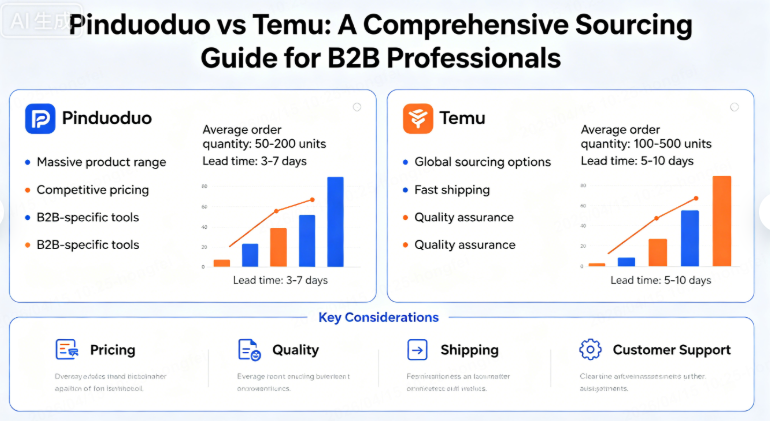
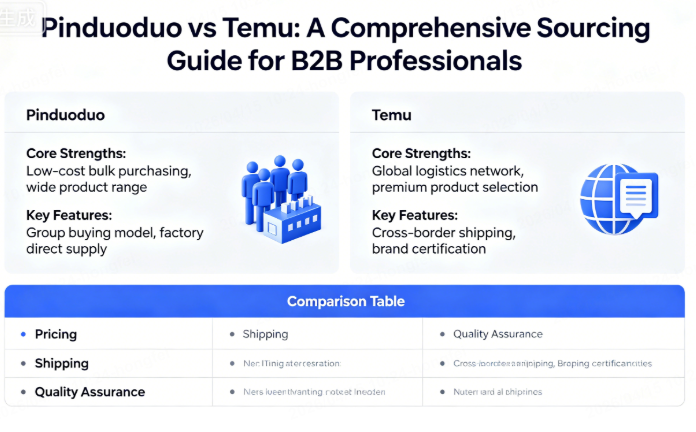
- Pinduoduo (PDD): The foundation of the empire, this Chinese domestic platform revolutionized social commerce through group-buying. It directly connects rural agricultural producers and factory owners with over 900 million consumers in China [2, 3, 5].
- Temu: The global expansion of this model, Temu brings the same “factory-to-consumer” philosophy to over 86 countries [3, 6]. By aggressively removing traditional middlemen, Temu offers ultra-low prices that have challenged the dominance of established retail giants like Amazon [4, 6].
Critical Differences: Why B2B Sourcing Requires More
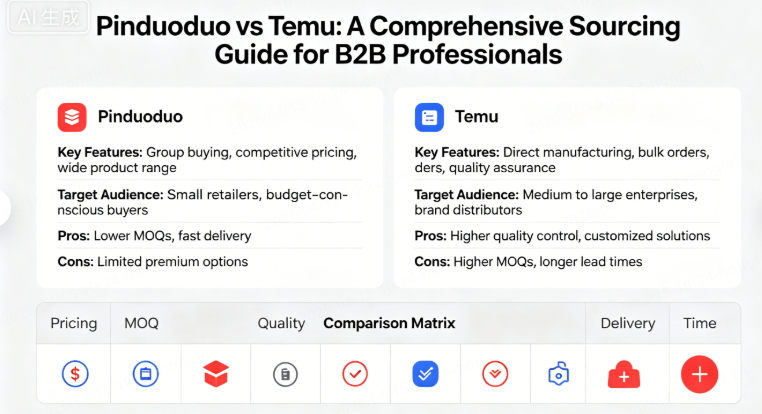
While both apps are revolutionary for retail, they are not B2B sourcing platforms [13, 18]. The fundamental structure of these apps is optimized for high-velocity, low-value retail efficiency, not complex commercial procurement.
| Feature | Pinduoduo / Temu (Retail) | B2B Sourcing Platforms |
|---|---|---|
| Primary Audience | End Consumers | Wholesalers, Brands, Manufacturers [18] |
| Sourcing Purpose | Product/Price Benchmarking | Direct Bulk Procurement [18] |
| Logistics | Parcel/Last-mile (Retail) | Commercial/Freight (Bulk) [18] |
| Quality Control | None (Self-service) | Multi-stage Inspections [18] |
| Compliance | Minimal/Retail-focused | Full Audit Documentation [10] |
The Hidden Risks of Sourcing on Retail Apps
Many businesses attempt to utilize Temu to source inventory for their own stores, but they often encounter significant, costly pitfalls:
- Quality Inconsistency: Because these platforms aggregate goods from thousands of independent sellers, quality can fluctuate wildly between orders [7]. There is no “Golden Sample” verification process.
- Compliance & ESG Risks: Retail platforms often lack the transparency required for international compliance, exposing buyers to risks regarding labor standards, safety certifications (e.g., CE, UL), and environmental regulations [10, 13].
- Logistical Inefficiency: Retail parcel shipping is not designed to handle bulk, palletized inventory, leading to customs clearance nightmares, unpredictable VAT/tax implications, and exorbitant shipping costs for large volumes [7, 18].
Expert Insight: Using Retail Insights to Power B2B Success
Instead of attempting direct procurement on Temu, forward-thinking buyers use these platforms for Strategic Sourcing Intelligence. Think of these platforms as a “Market Radar” rather than your “Warehouse.”
- Trend Discovery: Monitor Temu’s “Best Sellers” and “Rising Trends” to identify emerging consumer preferences in your niche before they scale globally [13].
- Competitive Pricing Benchmarking: Use retail pricing as a baseline for your own product development costs. If a retail product is priced at $5, you know your target ex-factory price needs to be significantly lower to maintain margins.
- Transition to Professional Channels: Once a product is identified, use that information to find the actual factory via a professional sourcing partner. A One-Stop B2B Sourcing Platform provides:
- Verified Supplier Access: Direct connections to factories that have passed rigorous compliance and quality audits.
- Commercial Logistics: Professional management of bulk freight, customs declarations, and duty-paid delivery, saving 20-30% on logistics costs.
- End-to-End Support: Dedicated agents to manage negotiation, quality inspection, and complex technical specifications.
The Anatomy of a Professional Sourcing Strategy
To compete effectively in today’s volatile market, do not rely on retail apps to drive your entire supply chain. A robust, expert-led strategy involves three distinct phases:
- Phase 1: Intelligence: Use Pinduoduo and Temu to research trends, consumer pricing, and product materials [13]. Treat these sites as a real-time database of what the market currently wants.
- Phase 2: Verification: Work with a trusted B2B sourcing platform to locate the high-capacity manufacturers of those products. Do not settle for the first reseller you find.
- Phase 3: Scaling: Utilize professional procurement tools to manage bulk orders, secure custom branding (OEM/ODM), enforce stringent quality control (AQL standards), and streamline global logistics [1, 10, 18].
Why One-Stop Platforms Win for B2B
Retail apps are designed for speed to consumer; B2B platforms are designed for long-term reliability and profit stability. A professional sourcing platform provides the infrastructure that Temu cannot: contract enforcement, payment protection, and the ability to customize products to your specific brand identity. By bypassing the retail interface and connecting directly to manufacturing capacity through a consolidated platform, businesses can reduce their sourcing lead times and significantly improve their product quality-to-price ratio.
Conclusion
While Pinduoduo vs Temu remains a hot topic in retail, the B2B professional must view these platforms as market intelligence tools rather than procurement partners. For long-term growth, reliability, and quality control, leveraging dedicated B2B sourcing services is essential. Your supply chain is the backbone of your brand—ensure it is built on professional foundations, not retail retail algorithms.
References
- [1] PDD Holdings: The Growth Logic Behind Pinduoduo and Temu
- [2] The C2M Revolution in Chinese Manufacturing
- [3] Temu vs. Pinduoduo: Strategic Insights for Logistics
- [4] B2B Sourcing Platforms Explained: 2026 Guide
- [5] Pinduoduo’s Social Commerce Model
- [6] Temu Global Market Expansion Strategy
- [7] Risks of Direct-to-Consumer Sourcing for SMEs
- [10] Pinduoduo and B2B: Insights from Import Professionals
- [12] The Rise of China’s Cross-Border E-Commerce Dragons
- [13] Mastering Global Sourcing in 2026
- [18] Top 10 B2B Marketplaces in China 2025
Frequently Asked Questions (FAQ)
1. Can I source inventory for my shop directly from Temu?
While you can technically place orders, it is highly risky. Temu is a retail platform, not a wholesaler. You will lack quality guarantees, bulk shipping solutions, and B2B support [18].
2. How do Pinduoduo and Temu keep prices so low?
They utilize a C2M (Consumer-to-Manufacturer) model, removing traditional intermediaries, warehouses, and storefronts, and leveraging massive economies of scale through direct factory connections [4, 5].
3. What is the best way to source products from China for my business?
For B2B needs, use a specialized One-Stop B2B Sourcing Platform. These services handle supplier verification, quality inspection, custom branding, and professional international logistics [13, 18].
4. Why is sourcing via a B2B platform safer than using retail apps?
B2B platforms provide structured processes for contracts, quality assurance, compliance checks, and secure, commercial-scale logistics, which are entirely absent on retail platforms [10, 18].
5. How can I use Temu to improve my product range?
Use Temu for real-time market data. Spot high-demand, low-cost trends, then use that intelligence to source higher-quality, customizable versions through professional wholesale channels [13].
Article Brief:
This article provides a strategic analysis of the Pinduoduo vs Temu e-commerce models for B2B buyers. It identifies these platforms as powerful tools for market intelligence, trend spotting, and price benchmarking, while warning against their use for direct wholesale procurement. The guide emphasizes the importance of partnering with specialized B2B sourcing platforms to ensure quality, compliance, and supply chain efficiency, helping brands transition from retail insight to professional wholesale execution.
Hot tags: B2B Sourcing, Wholesale Procurement, Chinese Manufacturers, C2M Model, Supply Chain Management, One-Stop Sourcing Platform, OEM/ODM Services, Import/Export Logistics, Quality Inspection, Global Trade Intelligence.